
Reveal: Three Effective Methods to Improve the Quality of Wave Springs
Source of articles:www.tembdq.com
Release time:2026/1/4 13:52:24
The main methods to improve the quality of wave spring are as follows:
1. Deformation heat treatment
Combining deformation strengthening with heat treatment strengthening can further enhance the strength and toughness of steel. Thermo-mechanical treatment can be divided into high, medium, and low temperature treatments. High-temperature thermo-mechanical treatment involves quenching immediately after deformation in a stable austenite state, which can also be combined with forging or hot rolling, that is, quenching immediately after hot forming. Thermo-mechanical treatment has been applied in the production of automotive leaf springs.
2. Relaxation processing
When springs work under external force for a long time, due to stress relaxation, they may undergo a slight amount of permanent (plastic) deformation. This is especially pronounced in springs operating at high temperatures, where stress relaxation becomes more severe, leading to a reduction in spring accuracy, which is unacceptable for general precision springs. Therefore, such springs should undergo relaxation treatment after quenching and tempering - by pre-loading the spring to ensure that its deformation exceeds the amount that may occur during operation. Subsequently, the spring should be heated to a temperature 20°C higher than its operating temperature and held for 8-24 hours.
3. Shot peening treatment
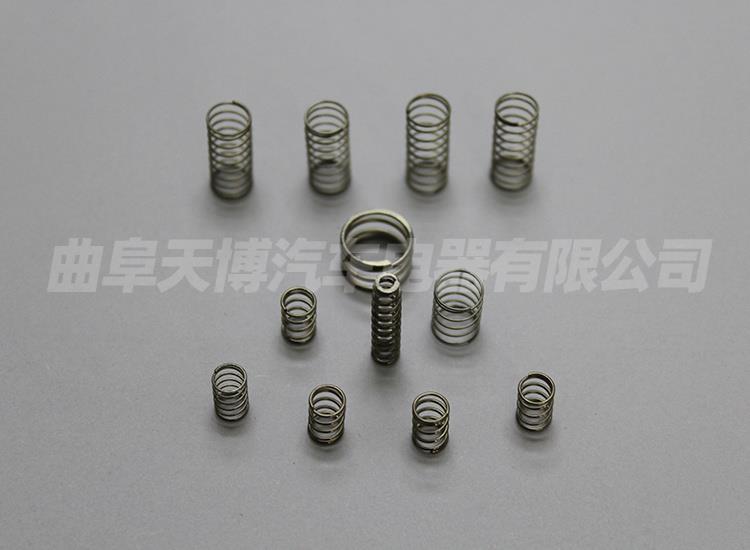
Surface defects such as scratches, folds, and oxidation decarburization often become stress concentration areas and fatigue fracture sources during spring operation. If small steel balls are sprayed onto the surface of the spring at high speed, it not only improves the surface quality and strength of the spring, but also puts the surface in a state of compressive stress, thereby increasing the fatigue strength and service life of the spring.
During the operation, the following points should be noted:
(1) Check the surface for defects such as decarburization and cracks before heat treatment. These surface defects will seriously reduce the fatigue limit of the spring.
(2) Special attention should be paid to preventing overheating and decarburization during quenching heating, performing salt bath deoxidation, controlling the furnace gas atmosphere, and strictly controlling the heating temperature and time.
(3) To reduce deformation. The loading method of springs during heating. Fixture form and quenching cooling method during cooling.
(4) After quenching, it is necessary to temper as soon as possible. Heat evenly as much as possible. Rapid cooling after tempering can prevent tempering brittleness and surface compressive stress. Improve fatigue strength.
The above are the ways and methods to effectively improve the quality of corrugated springs. Have you learned about them today? I hope it can be helpful for your future use. For more information on the use of corrugated springs, please feel free to visit our official website for more details!