
What are the specific structural classifications of clutch springs based on?
Source of articles:www.tembdq.com
Release time:2026/1/4 14:24:37
I believe everyone is familiar with clutch springs, which are widely used in many industries. Although a spring is an inconspicuous small accessory, it plays a crucial role and is one of the indispensable small accessories in many devices. Can you imagine that springs are also divided into many types, and different classifications have different functions? Next, let the manufacturer of clutch springs explain them to you in detail.
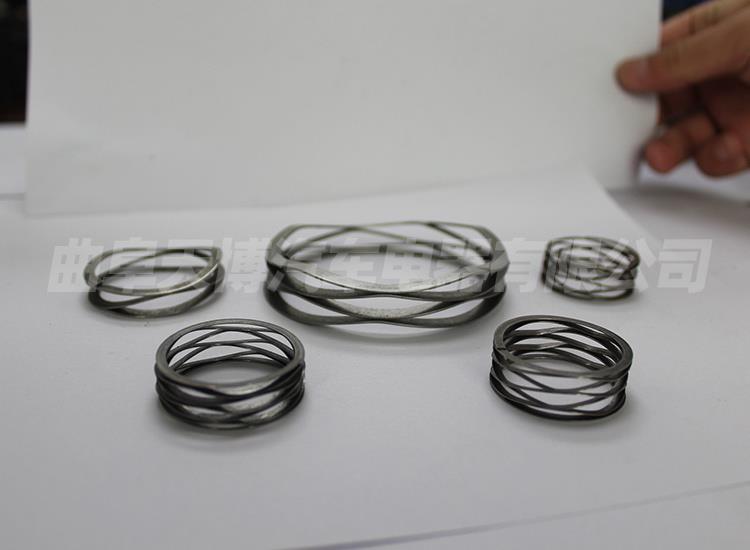
A torsion spring is a spring that can withstand torsional deformation, and its working part is also tightly wound into a spiral shape. The end structure of a torsion spring is a twisted arm processed into various shapes, rather than a hook ring. The torsion spring utilizes the lever principle to twist or rotate elastic materials that are soft and have high toughness, giving them great mechanical energy.
A tension spring is a spiral spring that withstands axial tension. When not under load, the coils of the tension spring are usually tightly connected without any gaps. Compression springs are spiral springs that withstand axial pressure. The materials used for compression springs are mostly circular in cross-section, but can also be made of rectangular or multi strand steel coils. The springs are generally of equal pitch, and the shapes of compression springs include cylindrical, conical, convex and concave, and a small amount of non-circular. There is a certain gap between the coils of compression springs, and when subjected to external loads, the springs contract and deform, storing deformation energy.
Progressive type spring, which adopts a design with inconsistent thickness and density, has the advantage of absorbing road surface undulations through the lower elastic coefficient when under low pressure, ensuring passenger comfort. When the pressure increases to a certain extent, the thicker part of the spring plays a role in supporting the vehicle body. However, the disadvantage of this type of spring is that the driving experience is not direct and the accuracy is poor.
Linear spring, with constant thickness and density from top to bottom, and a fixed elastic coefficient. This type of spring design can provide the vehicle with a more stable and linear dynamic response, which is beneficial for drivers to better control the vehicle. It is commonly used in performance oriented modified and competitive vehicles, but the downside is that comfort is affected. Short springs are shorter and more durable compared to original springs
Thick and sturdy, equipped with short springs, it can effectively lower the center of gravity of the vehicle, reduce the roll generated during cornering, make cornering more stable and smooth, and improve the vehicle's cornering handling. The damping setting of the original shock absorber tends to be comfortable, so the combination of short springs and original shock absorbers is not very stable. It cannot effectively suppress the rebound and compression of short springs. When driving on bumpy roads, there will be an uncomfortable jumping feeling. Over time, the service life of the shock absorber will be greatly reduced, and there may also be oil leakage. Of course, all of the above situations are relative. In daily driving, there will not be such serious damage, and it is best not to drive aggressively, as the original shock absorbers cannot withstand high load pressure.
The classification introduction of springs is as described in the previous text. That's all for today's sharing. I believe today's sharing will be helpful to you. If you have any questions related to it that you don't understand, please feel free to call us for consultation. Our company has many years of experience and we believe we can help you solve your doubts