
Global technology for low-speed warning sound of electric vehicles held in Baltimore, USA
Source of articles:www.tembdq.com
Release time:2026/1/4 15:42:35
This meeting compared and organized the contents of UN Regulation No. 138, EU Regulation (EU) No. 540/2014, US FMVSS 141, Canadian CMVSS 141, Japanese National Regulation TRIAS 43 (7) Art. 67.3, South Korean KMVSS 53.3 draft, Chinese GB 7258, and recommended national standards for electric vehicle warning sounds.
Xie Dongming from China Automotive Technology Research Center Co., Ltd. and Diao Peixuan from Handeli (Changzhou) Electronics Co., Ltd., on behalf of the Chinese government, submitted the document "GTRQRTV-06-08 (China) Introduction of China AVAS requirements and test methods of electric vehicles running at low speed", which elaborates on the current Chinese standards related to electric vehicle warning sound requirements and measurement methods, with a focus on analyzing the applicable scope and limit requirements of safety or technical requirements standards for electric vehicles such as GB 7258-2017, GB/T 28382-2012, GB/T 34585-2017, GB/T 32694-2016, and the GB/T XXXXX-20XX "Electric Vehicle Low Speed Warning Sound" standard currently under approval. The main correlations and differences in four aspects: pause switch, fixed sound, etc.
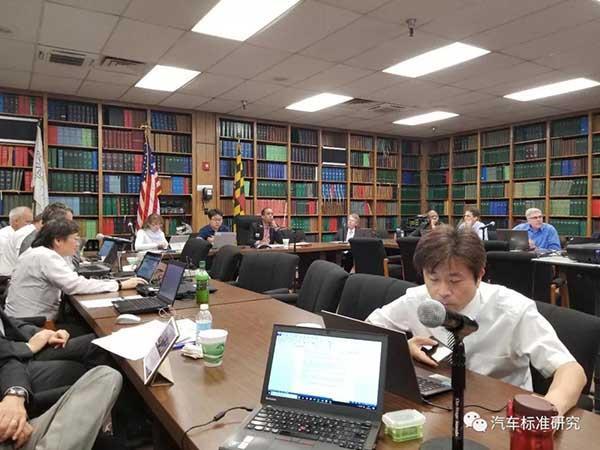
The meeting decided to select United Nations regulations, European Union regulations, US FMVSS, and Chinese standards as the four basic technical input contents, and conducted comprehensive analysis and comparison according to the scope of application, AVAS installation, whether the fixed position produces sound, the speed range of sound, reverse requirements, frequency shift requirements, volume adjustment requirements, frequency doubling sound pressure level requirements, minimum sound pressure level requirements, maximum sound pressure level requirements, measurement directionality, driver's optional sound types, sound consistency requirements, and the availability of indoor measurement methods. Comparison shows that there are significant differences between the United Nations regulations and the US FMVSS in terms of application scope, sound speed range, fixed sound, pause button installation, minimum and maximum total sound pressure level requirements. This will pose significant challenges for the design and use of AVAS systems in the future, and is also a technical content that needs to be discussed and coordinated in the formulation of future global regulations.
Renault, a member of the World Federation of Automobile Manufacturers, provided a detailed introduction to its sales of electric vehicles in Europe as a leader in electric vehicles, as well as a survey report on the use of electric vehicle warning sounds by over 300 Renault electric vehicle users in Germany and France. The report mainly covered the motivations for purchasing electric vehicles, users' perception of AVAS, users' selection of sound modes, use of pause switches, users' feelings towards sound, and demonstrated the significant differences in the perception and use of AVAS systems between Germany and France. This will have significant value for the revision of future United Nations and European Union regulations, as well as the development of global technical regulations.
At present, the regulations or technical requirements for low-speed warning sounds of electric vehicles in major countries and regions around the world have been basically determined. The subsequent global regulatory development work will be comprehensively accelerated, and the seventh meeting of the informal working group will be held in Geneva, Switzerland in September 2018.