
What are the common causes of malfunctions in electronic snail horn coils?
Source of articles:www.tembdq.com
Release time:2026/1/4 13:45:36
To understand why the speaker coil may malfunction, one must first have a basic understanding of the speaker coil. The speaker coil is primarily a device that assists in converting electrical signals into acoustic signals. A simple speaker coil consists of a coil, a magnet, a paper cone, etc. The principle behind the speaker producing sound is that when current passes through the coil on the speaker and cuts through magnetic lines of force, the coil simultaneously drives the speaker's diaphragm (paper cone) to vibrate. The amplitude and direction of the vibration change according to the magnitude and direction of the current. The vibration of the paper cone also causes the air to vibrate, thereby producing sound. Reasons for speaker coil malfunction:
1. Contact erosion: If a horn is used for an extended period, it is prone to cause contact erosion, leading to impedance. This reduces the current flowing through the electromagnetic coil, and the electromagnetic attraction force decreases, making it impossible to attract the armature of the horn coil to drive the diaphragm to vibrate normally. Consequently, the horn produces a hoarse sound or even fails to sound. However, when the horn is pressed continuously, if a strong instantaneous current passes through the impedance, it can still work normally, which explains why it may function intermittently.
2. Poor contact of horn coil terminals: The failure to thoroughly remove the insulating paint on the end of the enameled wire of the internal coil of the horn or the loose rivet crimping can easily lead to faulty connections, resulting in issues such as single tone and poor sound quality when the horn is operated.
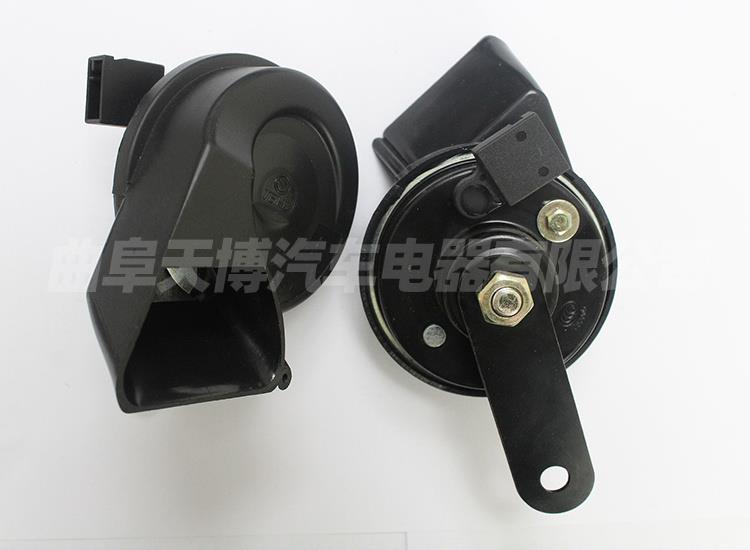
3. Mechanical failure: After prolonged operation, the speaker coil is prone to experiencing paper disc displacement beyond its intended range due to friction with the magnetic core, resulting in separation from the coil. Alternatively, the paper disc may become folded or the speaker support ring may deform, leading to voice coil displacement. Any of these scenarios can cause the speaker to malfunction.
4. High-temperature burnout: Driving the speaker at overload for an extended period exposes the coil enameled wire to high temperatures. Under overload conditions, the conductive parts may experience poor contact, leading to increased contact resistance. This significantly reduces the insulation strength of the inductive coil, resulting in the coil cracking or burning out.
5. Working environment: The interior of the speaker is a sealed environment. However, if the seal is not tight, moisture or fog can easily penetrate into the coil, causing the insulating part of the coil to become damp, and thus rendering the speaker inoperative.
That concludes the introduction to the common causes of electronic snail horn coil malfunctions. I believe it should be helpful to you after reading. If you have any needs or questions, please visit our official website or call us. Our dedicated staff will be happy to assist you.
- Next article:Briefly describe how the snail horn is adjusted?
- Next article:What functions does a wave spring possess?