
Briefly describe the five common problems in processing pressure regulating springs!
Source of articles:www.tembdq.com
Release time:2026/1/4 13:48:11
1. According to product requirements, the support ring can be assembled using either cold joining or hot joining methods. When using hot joining, the spring must not be heated to the point where it sparks or turns white, and the temperature of the silicon-manganese steel must not exceed 850°C. The support ring should make effective contact with the effective ring, with the gap not exceeding 10% of the nominal gap between the rings.
2. The characteristics of multi-strand springs can be determined by adjusting the lead, and the lay length can be adjusted as necessary during winding. The pitch can be taken as 3 to 14 times the wire diameter, but generally 8 to 13 times is preferred. The spring force is also closely related to the free height, end coils, outer diameter, and wire properties, and can be changed by adjusting one or more of these factors.
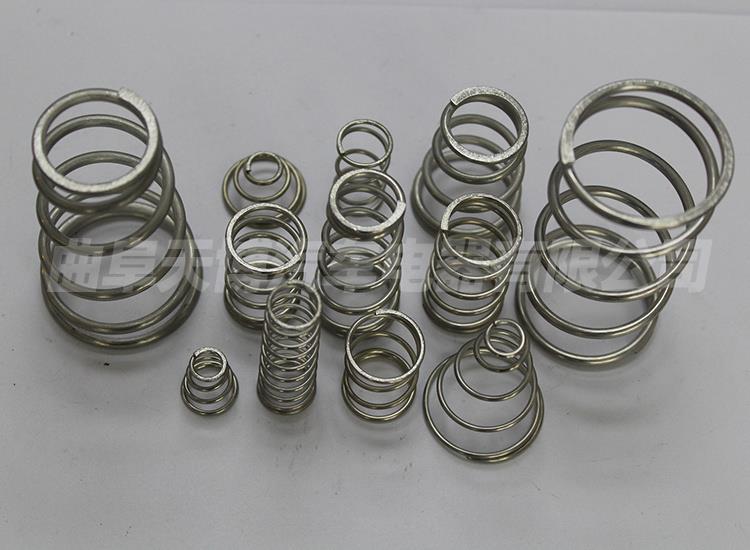
3. Springs without support rings and those with excessively thin wire diameters should not have spring ends welded. However, the end steel wires should not have obvious looseness and should be deburred. For multi-strand springs that require welding at the head, the length of the welding area should be less than 3 times the wire diameter (with a maximum length of no more than 10 millimeters). The heating length should be less than one circle, and the welding area should be polished smooth after welding. During gas welding, the welding area should undergo local low-temperature annealing.
4. The surface treatment of springs is generally sufficient with phosphating treatment, but other treatments can also be applied. When plating with zinc and cadmium, hydrogen removal treatment should be performed after electroplating, followed by a 3% retest for setting treatment. There must be no fracture during the retest. The surface of the spring should be cleaned of dirt, salt stains, and oxide scale, which can be achieved by sandblasting or gasoline cleaning, but not acid cleaning.
5. The compression time for important springs is 24 hours, while for ordinary springs, it is 6 hours or 3 to 5 consecutive compressions, with each compression lasting for 3 to 5 seconds. During compression, the gap between the spring and the mandrel should be 10% of the mandrel's diameter. If the gap is too small, it will be difficult to operate, while if it is too large, the spring is prone to bending and deformation. If one of the springs breaks during compression, the rest should be reprocessed.
The above are the five common issues related to machining pressure-adjusting springs that we have detailed for you. We hope you can gain some substantial reference value from this article. If you have any other questions, please feel free to consult us. Thank you for watching!
- Next article:What functions does a wave spring possess?
- Next article:Why do electronic snail horns often have "minor issues"?