
Share several methods to improve the quality of corrugated spring usage
Source of articles:www.tembdq.com
Release time:2026/1/4 14:15:20
Ripple spring is a thin circular elastic metal component composed of several peaks and valleys. Due to its special function of reducing noise and vibration, it is widely used in industries such as motors, textile machinery, hydraulic equipment, and automobiles. But to ensure the service life of corrugated springs, it is necessary to learn some measures to improve their inherent quality. So, what can be done to effectively improve the quality of corrugated springs? Next, let's follow the editor to learn more.
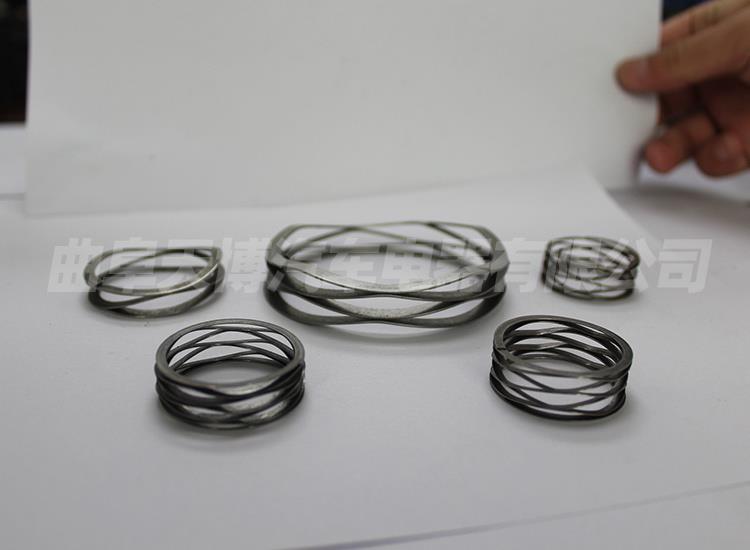
The main methods to improve the quality of corrugated springs are as follows:
1. Deformation heat treatment
Combining deformation strengthening and heat treatment strengthening of steel to further improve its strength and toughness. Deformation heat treatment can be classified into high, medium, and low temperatures. High temperature deformation heat treatment is quenching immediately after deformation occurs in a stable austenite state, or it can be combined with forging or hot rolling, that is, quenching immediately after hot forming. Deformation heat treatment has been applied in the production of automotive leaf springs.
2. Relaxation treatment
When a spring works under external force for a long time, it will produce trace permanent (plastic) deformation due to stress relaxation, especially for springs working at high temperatures. The stress relaxation phenomenon is more severe at high temperatures, which reduces the accuracy of the spring. This is not allowed for general precision springs. Therefore, these types of springs should undergo relaxation treatment after quenching and tempering - by preloading the spring with a load that exceeds the deformation that may occur during spring operation. Then heat it at a temperature higher than the working temperature of 20C and keep it at that temperature for 8-24 hours.
3. Shot peening treatment
Surface defects such as scratches, folds, and oxidation decarburization often become stress concentration areas and fatigue fracture sources during spring operation. If small steel balls are sprayed onto the surface of the spring at high speed, it not only improves the surface quality and strength of the spring, but also puts the surface in a state of compressive stress, thereby increasing the fatigue strength and service life of the spring.
During the operation, the following points should be noted:
(1) Check the surface for defects such as decarburization and cracks before heat treatment. These surface defects will seriously reduce the fatigue limit of the spring.
(2) Special attention should be paid to preventing overheating and decarburization during quenching heating, performing salt bath deoxidation, controlling the furnace gas atmosphere, and strictly controlling the heating temperature and time.
(3) To reduce deformation. The loading method of springs during heating. Fixture form and quenching cooling method during cooling.
Only by learning the methods mentioned in the article by the corrugated spring manufacturer to improve the quality of spring use can we ensure its good performance and service life. The article ends here. If you want to learn more about it, please continue to follow the updates on this website. Thank you for reading