
Several requirements in the process of manufacturing pressure regulating springs
Source of articles:www.tembdq.com
Release time:2026/1/4 15:20:36
Pressure regulating springs are widely used elastic components in the mechanical and electronic industries. Springs can undergo significant elastic deformation under load, and then convert mechanical or kinetic energy into deformation energy. The manufacturing materials of pressure regulating springs also have high elastic limits, fatigue limits, and good heat treatment performance. So, what are the requirements for manufacturing pressure regulating springs? Next, let's follow the editor to learn more about it in detail.
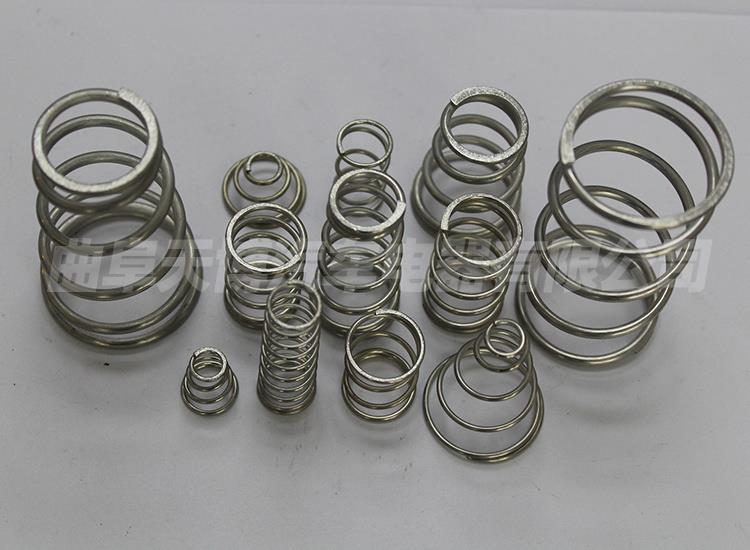
Several requirements for manufacturing pressure regulating springs:
1. The pressure regulating spring should be treated with high pressure. This processing method can be loaded at a pressure level for more than 12 hours or maintained for a short period of time, with a pressure level not less than 5 times. The pressure should not be less than 2 times Pf=0.75h. The free height HO of the pressure regulating spring after treatment should meet the requirements and keep the condition stable. According to the test, the height of the pressure regulating spring cone will be reduced by more than 20% during the crushing process, so the design of the punching die must be expanded according to specific requirements.
2. The manufacturing direction and technical requirements for pressure regulating springs with different thicknesses are different. They are usually made of cold-rolled copper with a smooth surface, cold stamped into circular blank washers, and then annealed in a curved forming die cone shape with a thickness of 1mm6mm. They can be made of tropical holes or steel plates. Alternatively, after forging the copper plate, it can be heated and stamped. All surfaces must be cut or grounded. The edges of the inner and outer circles need to be rounded and ground to support the surface.
3. Pressure regulating springs should not be directly processed from rods or other blanks, but must be covered or formed to ensure the bearing's load-bearing capacity. After forming, the surface hardness should be within the range of HRC42-52 to ensure good elasticity and fatigue strength. Pressure regulating springs should be strictly prevented from increasing during heat treatment. The accuracy level of decarburization and repeated quenching of hot springs should be checked, and the depth of decarburization layer should be inspected. Finished products should not have burrs, surface defects such as cracks and spots at high temperatures or in disc springs, and should be removed. After salt bath quenching, marks or other surface contaminants should be removed.
4. The pressure regulating spring of the finished product will be inspected before leaving the factory, including surface treatment quality inspection, dimensional and shape tolerances of each component, as well as deviation inspection of load and deformation. The manufacturing accuracy of pressure regulating springs specified in the standard is divided into primary and intermediate levels. Considering the accuracy of the two types of coil springs at high temperatures, with a tolerance of hPf load=0.75, the thickness of the disc spring load, outer diameter and alignment, position tolerance of non parallel support surfaces, and so on.
5. The Jiaxiang pressure regulating spring, which is used to withstand alternating loads, is recommended to undergo surface strengthening treatment after quenching. For valve disc springs, special requirements and rust prevention, anti-corrosion treatment, shot blasting treatment, such as blue or cadmium plating, should be avoided as much as possible due to hydrogen plating.
The above is the small knowledge about the requirements for manufacturing pressure regulating springs that the editor has compiled for you. We hope it can be helpful for your future use. For more related information, the editor will continue to organize and share it with you in the later stage. We hope that interested friends will closely follow our latest developments.